Bloodborne · PlayStation 4 · Android (ARM64)
Bloodborne Android Port
 This Bloodborne Android port runs through an experimental ARM64 recompilation, not an emulator. The project translates the PS4 game's x86-64 code ahead of time and runs it natively on Snapdragon phones. Release 2.3.0 is a beta, needs your own Bloodborne 1.09 files, and supports Adreno GPUs only.
How to run Bloodborne on Android
- Install the current APK from the project's GitHub releases. The 2.3.0 build is signed with a new key, so uninstall any older version first and back up your saves from the old app's menu.
- Put your own Bloodborne 1.09 game on the phone: use Install from PKG with the base game and 1.09 update PKGs, or point the app at an extracted folder that holds eboot.bin, sce_module and sce_sys.
- Build the native code. The first start offers Build on this phone, which takes about 6 minutes on a Snapdragon 8 Gen 2 with the charger connected and roughly 4 GB of free RAM. A Windows, Linux or Apple Silicon PC can build the same libbbaot.so with the free Rebuild Tool.
- Start the game and keep the tuned defaults: GSR 2 at 1080p output with a 960x540 scene and a 60 FPS limit. Never share the libbbaot.so the build produces; it is translated from the game's own code and belongs to the copyright holders.
Game version you need
- Bloodborne for PlayStation 4, version 1.09, from a copy you own. The project was tested with CUSA03173; other 1.09 releases should work but are untested.
- The original 1.09 eboot.bin. Pre-patched 60 FPS eboot.bin files crash in the gestures menu.
- No game files are included or downloadable here. The APK ships the port's code only; the native library has to be built from your own game.
Hardware & system
- Android 9 or newer on arm64, with a Snapdragon SoC and an Adreno 6xx, 7xx or 8xx GPU. Mali GPUs are not supported; the bundled Mali driver is for testing only and does not run the game yet.
- Tested on AYN Thor (Snapdragon 8 Gen 2, Adreno 740) and Oppo Find N5 (Snapdragon 8 Elite, Adreno 830), both with 16 GB of RAM. Other Adreno devices are untested.
- Phone build: about 4 GB of free RAM and about 1 GB of free storage while it works, with the charger connected. PC build: 8 GB of free RAM, about 3 GB of disk, and AVX2 on Windows and Linux.
Project, release & known issues
The Android app and the PC Rebuild Tool are separate repositories from the same developer; the tool only produces the native library.
| Project | Type | Release | Status | Runs on | Game version | Last update |
|---|---|---|---|---|---|---|
| Bloodborne-AndroidStatic ARM64 recompilation of Bloodborne (PS4 1.09) for Snapdragon phones. GPL-2.0. Adds GSR 2 and FSR 3.1 upscaling, Bloodframe frame generation, on-screen controls, mods, cheats and online play through community servers. | Static recompilation | 2.3.0 | In ProgressBeta | Android 9+ · Snapdragon / AdrenoOwn Bloodborne 1.09 (CUSA03173 tested); build libbbaot.so on the phone or with the PC Rebuild Tool | 1.09, original eboot.bin | Nov 15, 2026 |
Known issues & caveats
- Beta software: the README calls the port experimental and the phone-side native-code build a beta measured on one device.
- Android 9+ and arm64 only, no Mali support, and only two Adreno devices are listed as tested.
- The first start needs a native-code build. Without a matching libbbaot.so the game does not start, and the app contains no x86 emulator.
- 2.3.0 uses a new signing key after the old keystore was lost, so it will not install over 2.2.1 or older. Uninstalling deletes app data unless saves were backed up or moved to shared storage.
- A pre-patched 60 FPS eboot.bin crashes in the gestures menu; use the original 1.09 file.
Running on Android
Screenshots from the project's README, showing the game running on the two devices its author lists as tested.
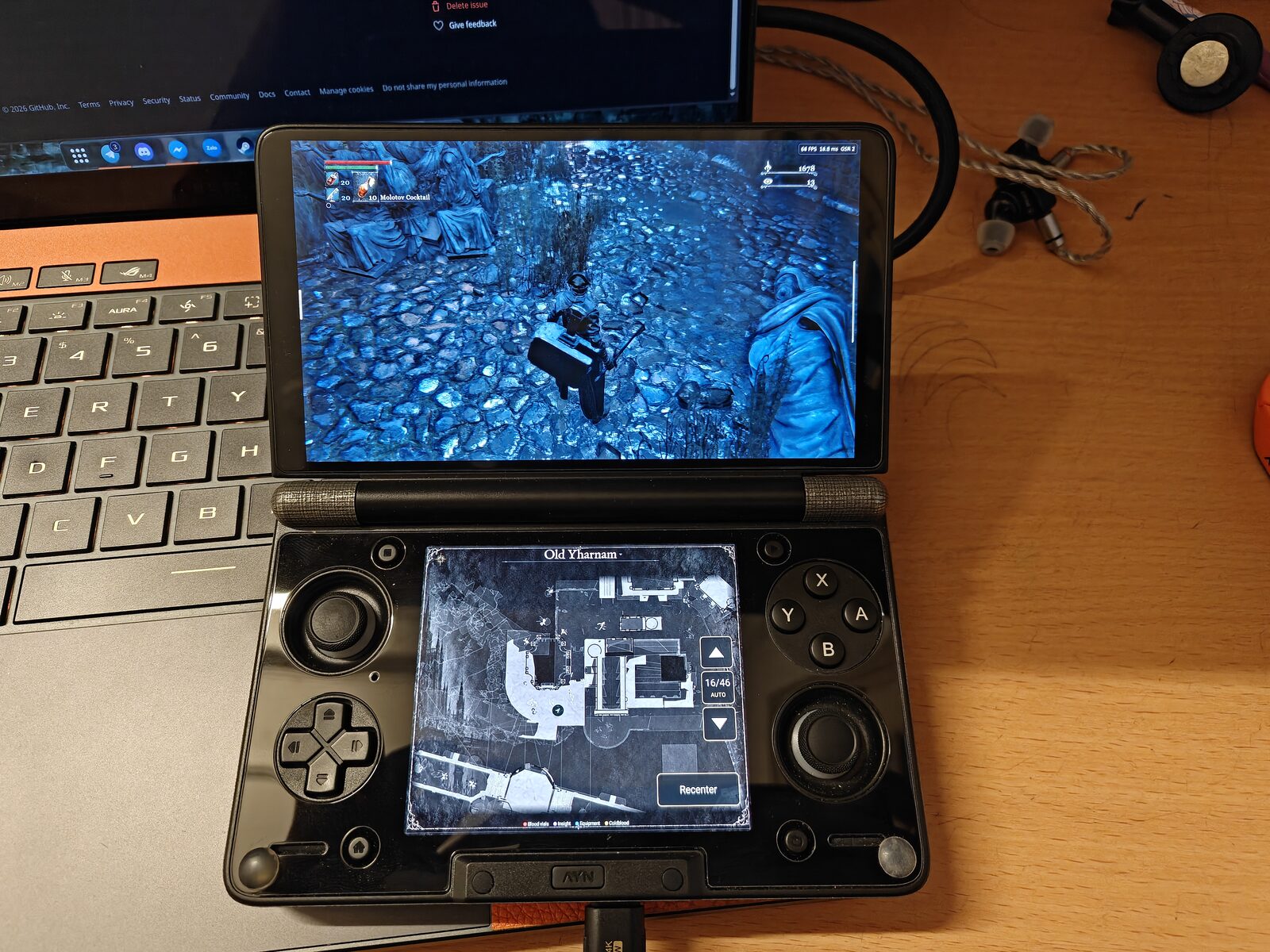
AYN Thor · Snapdragon 8 Gen 2 · Hunter's Atlas map on the second screen 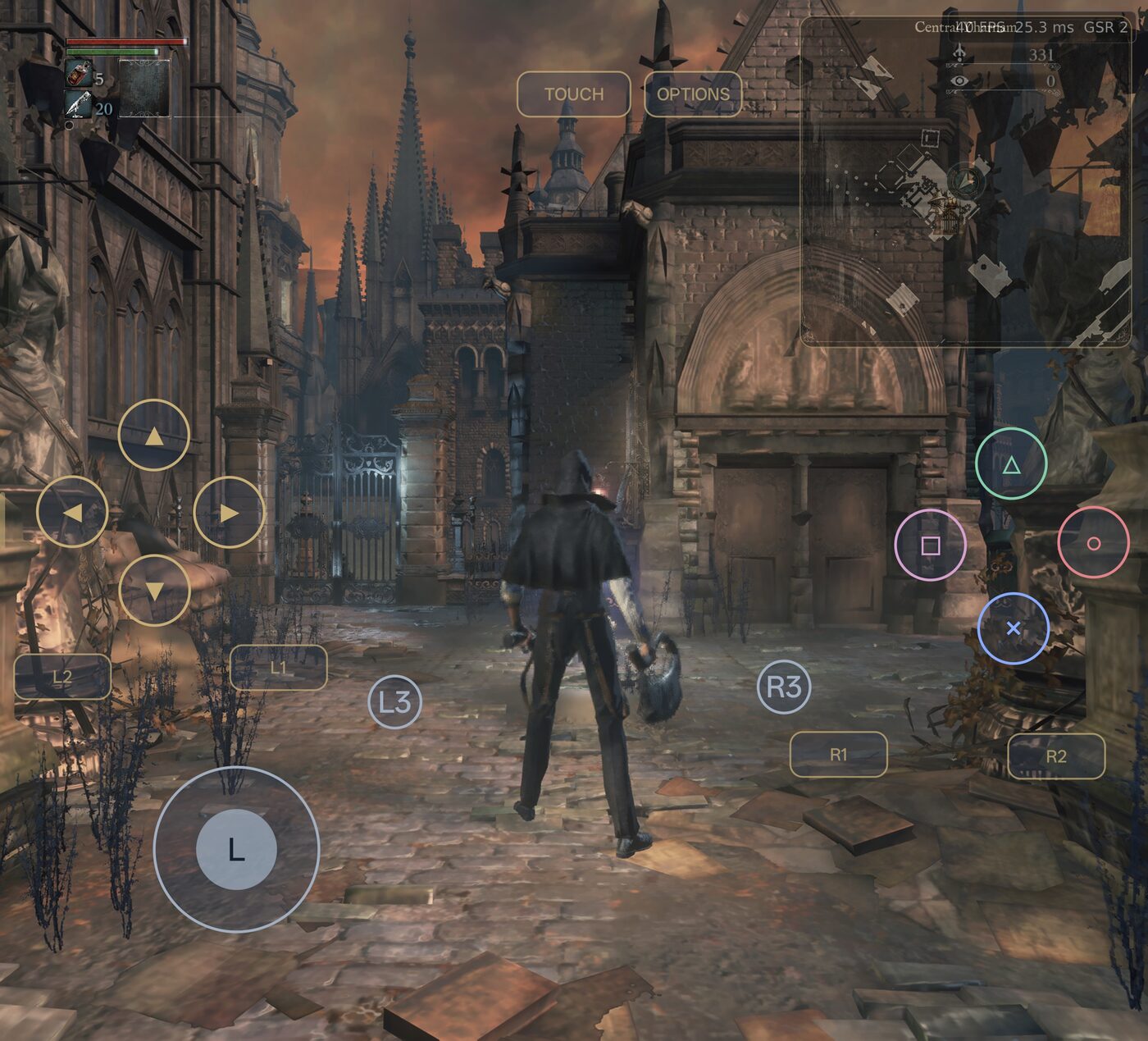
Oppo Find N5 · Snapdragon 8 Elite · on-screen controller and floating mini map
Screenshots from the Bloodborne-Android README; cover art © FromSoftware / Sony Interactive Entertainment, shown for identification.
Related links
Related Android ports on Recompedia
What the Bloodborne Android port is
Bloodborne-Android by ducvd89 is a static recompilation of the PlayStation 4 release. The app contains no x86 emulator: the game's own x86-64 program is translated once to ARM64 and saved as libbbaot.so, which the app checks and loads at every start. Because that library is derived from the game's code it cannot be distributed with the APK or downloaded anywhere, so it has to be built from files you own. The project is GPL-2.0 and labels itself experimental.
The port works from Bloodborne 1.09. You can install the base and update PKGs on the phone with Install from PKG, or point the app at an extracted folder containing eboot.bin, sce_module and sce_sys. The README says CUSA03173 is the tested release and other 1.09 releases should work but are untested. Since 2.1.0 the app can build the native library itself, or you can run the free Rebuild Tool on a Windows, Linux or Apple Silicon PC and copy the aot folder across.
Version 2.3.0 landed on November 15, 2026 and is the first build signed with a new key after the old keystore was lost, so it must go on after a clean uninstall; the release notes walk through backing up saves first. The 2.3.0 APK is about 61 MB and had more than 4,300 downloads by November 22, 2026. Recompedia checked the repository README and GitHub releases on that date and has not run the port on Android hardware.
Which phones can run it
The supported range is Snapdragon with Adreno 6xx, 7xx or 8xx graphics on Android 9 or newer, arm64 only. The README lists two tested devices: the AYN Thor with a Snapdragon 8 Gen 2 and Adreno 740, and the Oppo Find N5 with a Snapdragon 8 Elite and Adreno 830, both with 16 GB of RAM. Other Adreno phones are untested, and Mali GPUs are explicitly unsupported; the bundled Mali driver is included for testing and does not run the game yet.
Memory matters more than raw resolution. The project recommends staying at 1080p output or below on phones with less than 12 GB of RAM, and its texture quality setting drops to half automatically at 12 GB or less. On the Thor the defaults are GSR 2 Performance at 1080p output, a 960x540 scene, costly effects off, the lowest model detail and a 60 FPS limit.
Emulator, decompilation or recompilation?
This is not an emulator. An emulator such as shadPS4 interprets or just-in-time compiles the original PS4 code while you play; this project translates the game's x86-64 program once, ahead of time, into ARM64 and then runs that native code. That is the same static-recompilation idea used by the other projects in this database, applied to a PS4 title and a phone CPU.
It is also not a decompilation. No reconstructed source code of Bloodborne is involved, so there is no source tree to build or mod at that level. The practical consequence is the native-code step described above: an emulator takes a game dump and runs it, while this port needs a matching libbbaot.so produced from the exact game build you are playing. The project's Rebuild Tool is the program that does that translation.
What the port adds on top of the game
Graphics: GSR 2 is the default upscaler, with FSR 3.1 as an alternative, and Bloodframe adds frame generation from 2x to 4x. Bloodframe can use shaders from your own Lossless.dll through LSFG 3.1, or the bundled experimental MAKO-FG model, which is licensed CC BY-NC 4.0 for non-commercial use. A Turnip driver for Adreno 6xx, 7xx and 8xx is included and selected automatically.
Controls and play: an on-screen controller, physical controller support with button remapping and vibration, a selectable game language, mod packages, cheats, and a pause that triggers when you leave the app. Online play uses community servers, Seamless Hunt with an account from seamlesshunt.com or The Hunter's Dream with Discord sign-in; cheats and pause are disabled while online. Hunter's Atlas adds a live map on a second screen or as a floating mini map.
FAQ
Is there an official Bloodborne Android port?
No. Bloodborne-Android is an unofficial, experimental project by ducvd89. It is not endorsed by FromSoftware or Sony, and the game itself has never been released on Android.
Is Bloodborne on Android an emulator?
No. The port translates the PS4 game's x86-64 code to ARM64 ahead of time and runs the result natively. The app has no x86 emulator, which is why it needs a native library built from your own game.
Do I need to own Bloodborne to use this port?
Yes. You need your own PlayStation 4 copy at version 1.09, either as PKGs or an extracted game folder. The APK does not include game data, and the libbbaot.so build cannot be shared or downloaded.
Which phones can run the Bloodborne Android port?
Snapdragon phones with Adreno 6xx, 7xx or 8xx graphics on Android 9 or newer, arm64 only. The README lists the AYN Thor (Snapdragon 8 Gen 2) and Oppo Find N5 (Snapdragon 8 Elite) as tested; Mali GPUs and other Adreno devices are not supported or untested.
How long does building the native code take?
About six minutes on a Snapdragon 8 Gen 2 with the charger connected, using roughly 4 GB of free RAM; the phone gets hot during the build. A Windows, Linux or Apple Silicon PC can build the same file with the free Rebuild Tool instead.
Can I use a 60 FPS patched eboot.bin?
No. The README says pre-patched 60 FPS eboot.bin files crash in the gestures menu. Use the original 1.09 eboot.bin; the port has its own FPS limit setting.
Does the port support controllers and online play?
Yes. It supports on-screen controls, physical controllers with remapping and vibration, and online play through the Seamless Hunt or The Hunter's Dream community servers. Cheats and pause are disabled while you are online.
Where are the game files?
They are not here. Recompedia does not host or link to game data. Install the APK from the project repository and supply Bloodborne 1.09 from a copy you own.
Nothing on this site replaces owning the game. No game files, ROMs, PKGs or native-code libraries are hosted, mirrored or linked here. Status checked against the project's README and GitHub releases on Nov 22, 2026.